
Pickleball scoring confuses everyone the first three times they hear it. There's a reason: the score is announced as three numbers (e.g. "3-2-1"), and only the serving side can score points. Once those two ideas click, the rest is easy.
This is the plain English version, with no jargon, with examples.
The basics
A standard pickleball game is played to 11 points, win by 2. So 11-9 wins, 11-10 doesn't.
Tournaments sometimes play to 15 or 21, same logic, just longer. We'll cover the standard 11-point game here.
Side-out scoring
The most important rule first: only the serving team can score points. If you're not serving, the best you can do is win the rally and earn the right to serve.
This is called "side-out" scoring. It's the same as old-school volleyball or badminton (pre-rally scoring). And it's why a single game of pickleball can stretch on if both teams are evenly matched.
When the serving team loses a rally, the serve passes to the other team, that's a "side out." When that happens in doubles, both members of the team that lost the serve don't lose a point, they just lose the right to serve until they earn it back.
The three-number call (doubles)
In doubles, the score is announced as three numbers before each serve:
Serving team's score - Receiving team's score - Server number
The "server number" is either 1 or 2, telling you which player on the serving team is currently serving.
Here's what that looks like in practice. Imagine your team is leading 5-3, and you're the second person on your team to serve in this rotation:
"5-3-2"
You serve, you win the point, your team is now 6-3, and you're still server #2 (you keep serving until your team loses a rally):
"6-3-2"
You serve, your team loses the rally. Now it's a side-out. The opposing team gets the serve:
"3-6-1"
Read out: opponents' score is 3, your team's score is 6, and the first server on the opposing team is now serving.
That's the whole structure. It's confusing in writing but obvious after one game.
The first-server exception
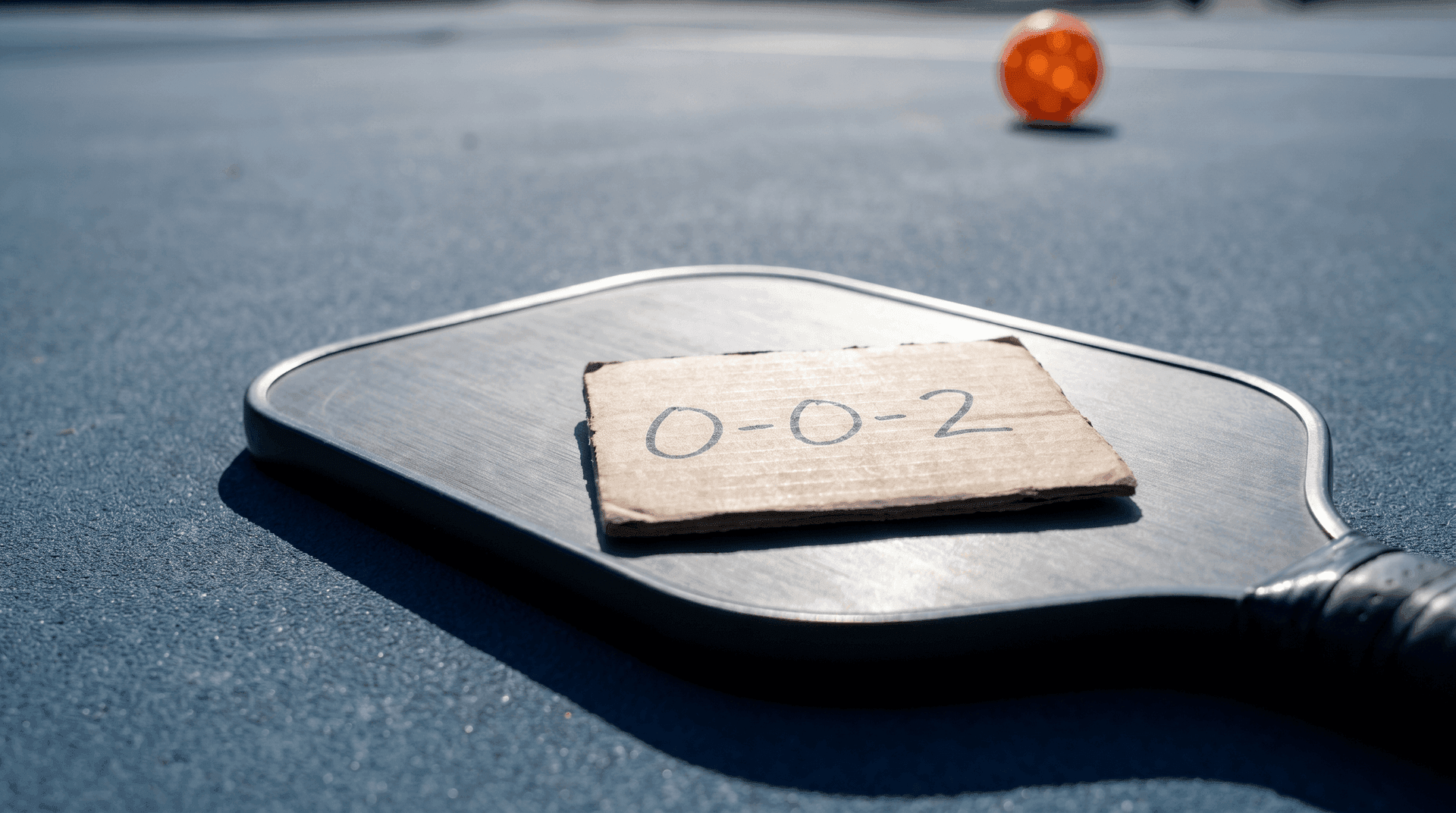
Here's the only quirk worth knowing. At the start of every game, the first serving team only gets one server. The score starts at "0-0-2." This evens out the inherent advantage of serving first.
After that first side-out, normal rotation resumes, both servers on each team get a turn until the side-out passes.
Singles scoring
In singles, the call is just two numbers: server's score, then receiver's score. There's no server number because there's only one player per side.
The serving side switches sides of the court based on whether their score is even or odd:
- Even score → serve from the right side
- Odd score → serve from the left side
This is true in doubles too, the serving player serves from whichever side matches their team's score.
Example: a complete game in three rallies
Two teams: A1, A2 vs B1, B2. Team A serves first.
Rally 1. Score is 0-0-2 (start of game, exception applies). A1 serves from the right. A1 wins the rally. Score becomes 1-0-2. A1 now serves from the left (odd score).
Rally 2. A1 serves again, but loses the rally. Side-out (because of the start-of-game exception). Now Team B serves. Score is 0-1-1.
Rally 3. B1 serves. B1 wins. Score is 1-1-1. B1 stays at the line and serves again, this time from the left.
…and so on. The same logic repeats until somebody hits 11 with a 2-point lead.
HK rally scoring (the local default)
This is the part most visiting players don't expect. A lot of HK open play uses rally scoring, not side-out. The reason is cultural: most local players grew up on badminton, which used the same system pickleball is borrowing. When pickleball arrived in HK, the badminton scoring came with it.
What's different
- Games go to 15, win by 2.
- Every rally scores. The team that wins the rally gets a point, regardless of who served.
- The score is called as two numbers, not three: serving team's score, then receiving team's score. The "server #1 or #2" idea doesn't exist here, because every server only gets one rally before the side-out.
- No game-start 0-0-2 exception. Whoever's on the right of the starting team just serves.
The even/odd rule is the same
The serving-side rule from standard pickleball carries straight over:
- Even score → server on the right side
- Odd score → server on the left side
What changes is when the parity advances. Under side-out scoring, your score only moves when your team is serving. Under rally scoring, your score moves every time you win a rally, including the rally that earned you the side-out.
So at every single side-out, the receiving team picks up a point as well as the serve. Their parity flips at that moment. The "right serves on even" rule still holds, but the score just shifted under your feet, so the opposite partner from who'd serve under side-out ends up at the line.
Worked example
Score is 0-0. Team A's right partner (A1) serves. A's score is even → right side. ✓
Team A loses the rally.
- Side-out: ball passes to Team B.
- Team B also wins +1 for that rally. Score is now A:0 - B:1.
- Team B's score is 1 (odd) → left partner (B2) serves next.
If you were running a standard-pickleball mental model, you'd expect Team B's right partner to serve here. Surprise.
The one-side variant
A small number of HK clubs use rally scoring but keep the server on one side regardless of score, to avoid confusion when stacking comes into play. You'll see it occasionally. If the format isn't obvious, ask before the first point.
Why it matters
If you walk onto an HK court assuming side-out to 11 with a three-number call, you'll get corrected fast. Ask which format the group uses before the first serve. The mechanics you already know carry over; you just have to remember every rally is a point and every side-out flips the parity.
Why the convention helps
The three-number call sounds clunky, but it serves a real purpose: it forces every player to acknowledge the score before each point. In friendly games, this prevents the very common dispute of "wait, who's leading?" In tournaments, it keeps refs accountable.
Get used to calling the score out loud. It feels weird for the first hour, then becomes second nature.
Quick cheat sheet
Standard (side-out)
- Game to 11, win by 2.
- Only serving side scores.
- Doubles call: serving score - receiving score - server number (1 or 2).
- Singles call: server's score - receiver's score.
- Even score → serve right side, odd → left.
- First serve of the game: only server #2 gets a turn.
HK rally (common at local open play)
- Game to 15, win by 2.
- Every rally scores.
- Doubles and singles call: just two numbers, serving score - receiving score.
- Even score → right, odd → left. Same as standard.
- No first-serve exception. Side-out comes with a point for the receiving team.
Print one of those, tape it to your paddle for one session, and you'll have it down before the second.
Want the full beginner rule set? Read the beginner rules guide next.